A Few Words on Fulford
In 1864, Fulford was named as such because the post office that opened in Simon Orcutt's house could not remain nameless. It was decided that the village would honour Francis Fulford, who was then the Anglican Bishop of Montreal.
Fulford is the northernmost community in Brome-Missisquoi, nestled in a valley at the foot of the Sutton and Brome mountains. The Yamaska River runs through it. Its main roads are Davis Road, which connects it to Waterloo to the north, and Fulford Road, which runs from Foster to Bromont.
The first settlers arrived from Dunham in 1830, but it was the construction of a sawmill in 1857 that led to the creation of the village. This was followed by the tannery opened by Fred and Seymour England in 1858 and the production of rafts and furniture by Lemuel Orcutt in 1861. Oscar George built a grain mill in 1863, followed by two mechanical workshops in 1864, as well as a few shops and craft stores. However, there were only twelve houses and 50 people in total.
In 1870, the township of Brome had about 3,500 inhabitants, three-quarters of whom were English-speaking. Fulford, which at the time had only 200 people, became a social centre for English and American settlers and their descendants.
The arrival of the Canadian Pacific Railway in 1884 facilitated the supply of commercial and industrial goods. Fulford did not have a passenger or freight station, but the delivery and shipment of prepaid goods was handled by a service station located in Foster, 7 km to the east.
A few French-Canadian families settled among the English-speaking population, forming a community of about 300 people by the end of the century. The first families to join were the Bessettes, Bouchards, Bourgeois, Dextradeurs and Gendreaus, and at first there were not enough of them to justify their own religious and educational services. They therefore began by joining those of Waterloo and West Shefford.
Finally, the Anglos sold a surplus building on the outskirts of the village to convert it into a Catholic school, which became the third to serve the village, in addition to Lewis and Fessender, both Protestant.
Forestry in the region began to decline in the early 20th century, and the Fulford mills were abandoned in 1912. The tannery founded by the England brothers and bought by American Erwin Joyal in 1989 was converted into a carpentry workshop in 1907. It lasted only 10 years. Where dozens of craftsmen once thrived, by 1907 only the blacksmith remained, and that year he moved to West Shefford.
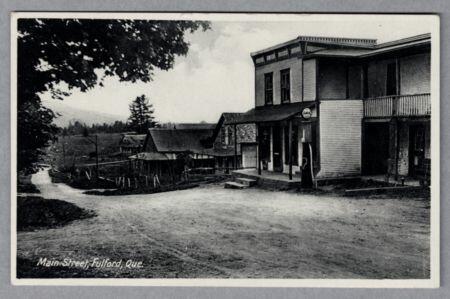
The front photograph on the postcard shows the old main street of Fulford and the buildings lining it. The message on the back indicates that the commercial building in front is located diagonally across from Marguerite's house.
Source: Brome County Historical Society
Faced with declining enrolment, students from both Protestant schools merged in Fessender, near the village, in 1900. There were 64 students in 1885, 28 in 1910 and 12 in 1945.
In 1971, Fulford was one of the villages incorporated into what we now know as Lac-Brome.
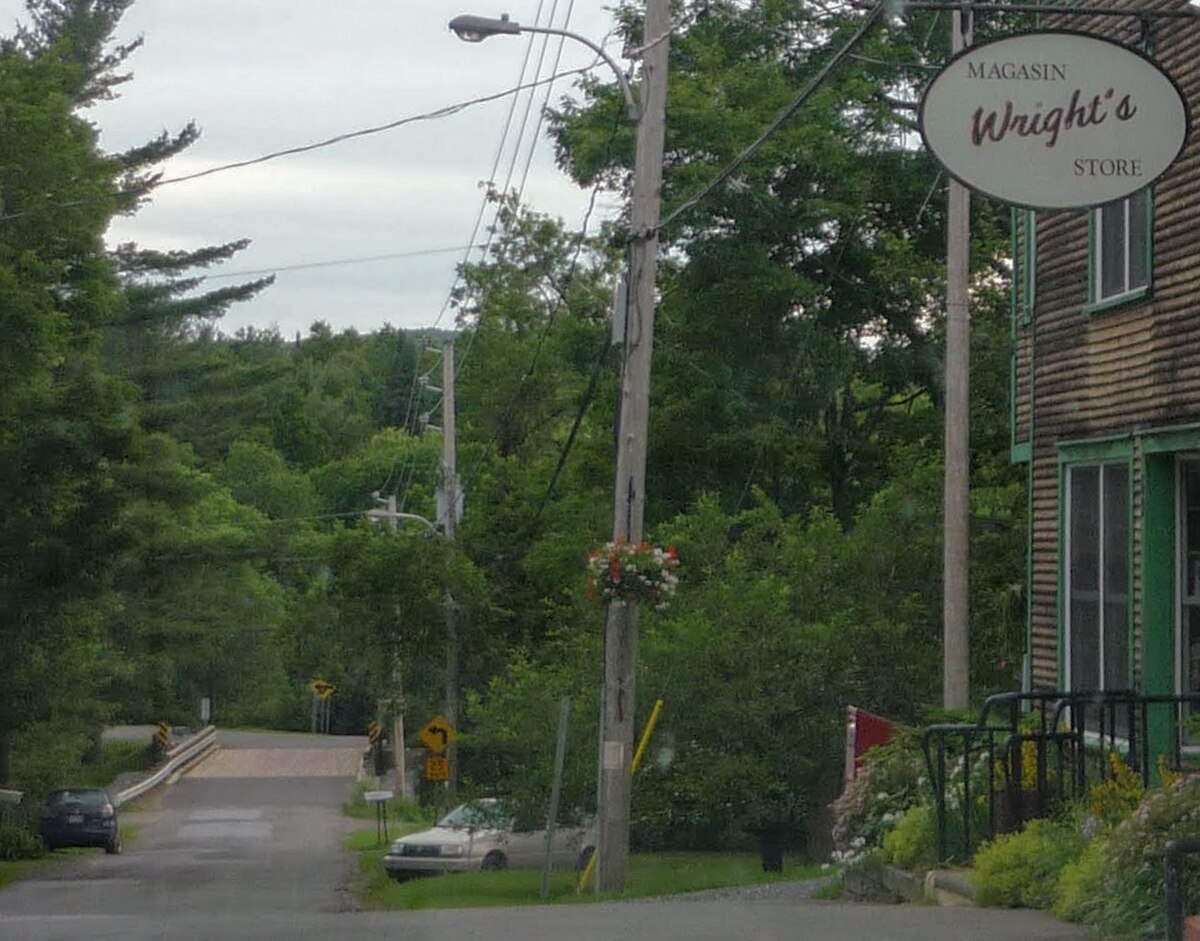
In 2020, the last vestige of the village's economic past, Wright's general store, closed its doors after retaining its original function.