
Let's Talk About Iron Hill
It is said that Iron Hill was named after surveyors discovered magnetic fields that interfered with their navigational compasses. Located between Bondville and West Shefford, in the heart of Mount Brome (which we all simply call Bromont). Before the post office opened in 1856, the hamlet was known as Brome Woods or The Cutting Neighbourhood. The latter name comes from the fact that the owner of the sawmill was named Isaac Cutting. Yes, you read that correctly. He opened the sawmill in 1840 and a flour mill in 1844. Isaac Cutting's mills paved the way for other craftsmen, such as a cartwright.
Although the Brome Township welcomed refugees as early as the late 18th century, Iron Hill was settled somewhat later, with the first recorded resident arriving in 1822. By 1831, the village had grown into a small colony. The reason for this late start was probably due to its hilly and remote location, where there were no communication routes. Many landowners attempted to develop the area, but it proved too difficult. The first to succeed, and therefore recognised as the founders of the village, were John Shufelt, Andrew Tibbitts, Joseph Benham, Moses Beard and Terrence Courtney.
The hamlet's beginnings were somewhat difficult, with local travellers being attacked by bandits and public buildings being regularly vandalised by children.
An Anglican mission led by Thomas Fyles was established in 1863. Initially, services and Sunday school were held in private homes and schools, but in 1864, Holy Trinity Church was built.
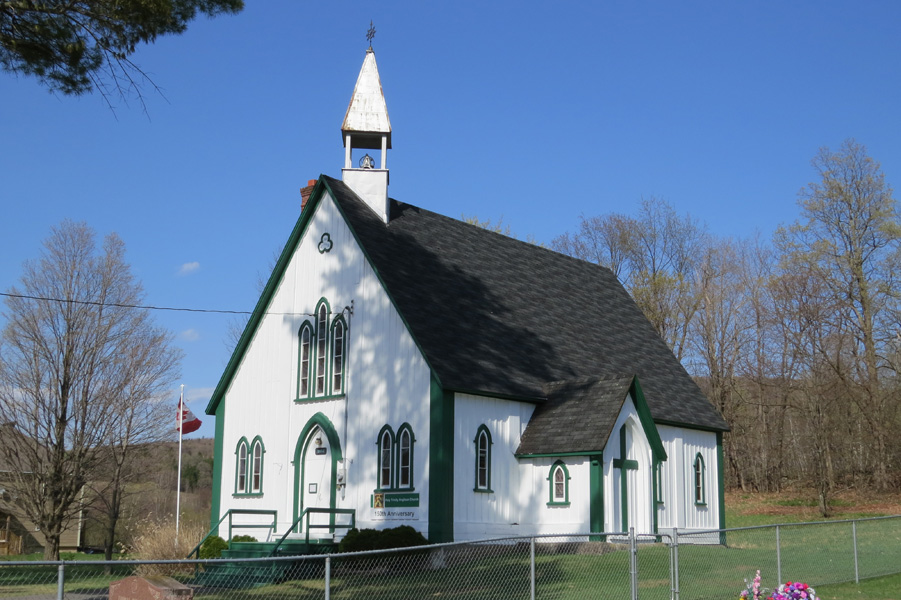
Thomas Fyles was ordained as a priest by the Bishop of Montreal and remained so until 1871.
Adventist and Baptist communities also formed, with enough members to justify a united church in 1889. The building was always full, and baptisms took place in the pond that fed the sawmill. The last Adventist celebration took place in 1930, but the church was not demolished until 1945.
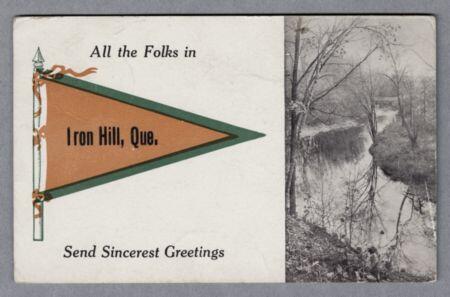
Postcard depicting a river at Iron Hill. An orange and green flag with the inscription Iron Hill, Que. can also be seen on the front. The message on the back, dated 9 March 1914, was sent by Mildred G. Beard to Mr. Sewell Hall. The message confirms that the sender received the recipients' Christmas card and notes that he had been away for two months and that the winter had been difficult..
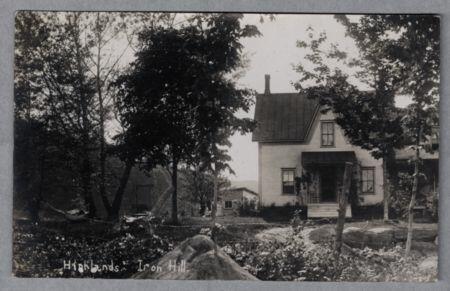
The front of the postcard shows the Highlands house in Iron Hill. A hammock can also be seen. The message on the back was sent to V. Pyeceoft from A. The message reads: ‘The train arrives in Montreal tomorrow. Bring a chicken (not a live one).’
Source: Brome County Historical Society
The post office, which opened in 1856, closed in 1968, and three years later, Iron Hill was incorporated into Lac-Brome, along with the other villages featured in this series, the next part of which will focus on West Brome and Foster.


